AI Marketing
AI marketing is moving from content generation to campaign execution
The Orchestra Team · September 21, 2026 · 4 min read
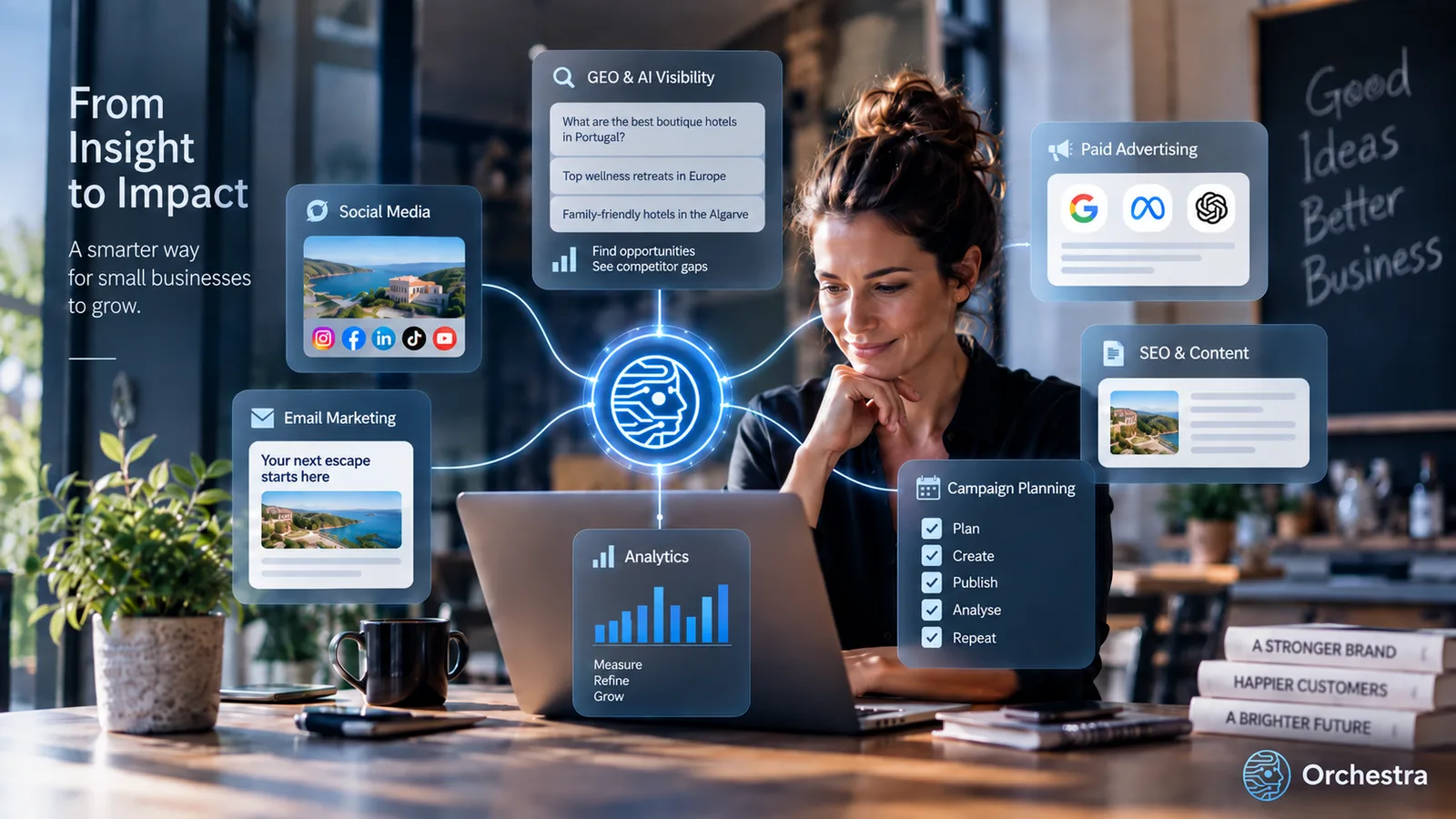
The list of things a small business is expected to manage under the heading of "marketing" keeps getting longer. Social channels, paid campaigns on Google and Meta, email, search rankings, reviews, analytics — and more recently visibility inside AI-generated answers, along with the first advertising formats built into conversational assistants. Each of those surfaces matured with its own specialist tool, and most small teams have accumulated several.
The production problem is largely solved
AI has changed the economics of one part of this picture dramatically. Producing marketing assets — a month of social posts, ad copy variations, product imagery, an email sequence — used to be the expensive part. It no longer is. Drafting that once took an agency a week now takes minutes, and the cost per asset has fallen accordingly.
Coordination is the remaining cost
What hasn't fallen is the cost of coordination. Individual AI tools are genuinely useful, but they tend to operate in isolation: the writing assistant doesn't know what the ad platform is testing, the SEO tool doesn't know which topics the email list responds to, and the analytics dashboard doesn't know what any of them were trying to achieve. In practice the business owner ends up acting as the integration layer — re-explaining the business to every tool, ferrying context between them, and reconciling the outputs into something coherent. A single seasonal promotion can touch four or five systems, each holding its own partial copy of the same campaign.
The opportunity has therefore shifted from producing assets faster to carrying the same business intelligence through research, strategy, campaign creation and execution without losing it at each hand-off.
From intelligence to execution
GEO — generative engine optimization — is a concrete example. A business can test how it appears in AI-generated answers, find the commercially relevant questions where competitors are mentioned and it isn't, and investigate why. Handled in isolation, that is a report. Handled inside a connected system, the same finding becomes a content brief, a positioning adjustment or a campaign worth running. Emerging conversational ad formats, including ChatGPT Ads, make the connection more direct still: the questions a business is absent from are increasingly the same places it can choose to advertise.
This is also the direction behind Orchestra Ads. The platform is being developed around a shared business context that moves from analysis and a Marketing Blueprint through SEO and GEO intelligence into content, advertising and campaign planning — so that what the system learns about a business in one place is available everywhere else it works.
Orchestra founder Gennaro "Rino" Pucci explores this shift in more detail in a new article published by TechBullion, examining the economics of AI marketing, the limitations of fragmented tools, GEO intelligence and the growing connection between market intelligence and campaign execution.
AI Marketing Automation for Small Businesses
The full analysis — economics, fragmented tools, GEO intelligence and campaign execution — published on TechBullion.
Read the full article on TechBullionExternal article · opens techbullion.com in a new tab
Closer to home, the Marketing Blueprint and the GEO audit show what the connected model looks like in practice.
More to come
We’re publishing a new article on AI visibility and GEO every week. Leave your email and we’ll tell you when the next one lands.
New articles only. Unsubscribe in one click, any time.